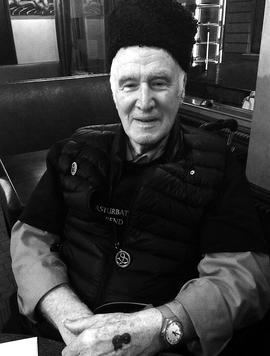
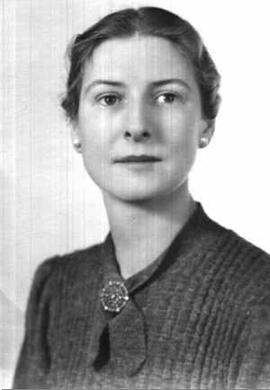
Flora Roy (1912-2008) was a professor at Wilfrid Laurier University in Waterloo, Ontario from 1948 until 1993. Roy received her BA and MA from the University of Saskatchewan and her PhD from the University of Toronto. In 1948 she became a professor in the English Department at Waterloo College (now Wilfrid Laurier University), and served as Department Chair for 30 years. Roy retired from full time teaching in 1978 but continued to teach on a part-time basis until 1993. She received the Confederation Medal in 1967, Queen Elizabeth II Jubilee Medal in 1978, Wilfrid Laurier University Language Arts Award in 1984, and the Wilfrid Laurier University Alumni Association Distinguished Educator award in 1995. In 1988 Flora Roy received an honorary degree from Wilfrid Laurier University.
The Evangelical Lutheran Seminary of Canada began in 1911. In 1924 Waterloo College was established, providing courses in post-secondary education. In 1960 Waterloo Lutheran University was formed, consisting of Waterloo University College and Waterloo Lutheran Seminary. In 1973 the name of the University was changed to Wilfrid Laurier University, with Waterloo Lutheran Seminary as a federated college.
Harold Russell was a student at Waterloo College from 1954 to 1958. He was a member of the Waterloo College Detachment of the University of Western Ontario Contingent of the Canadian Officers' Training Corps.
Jim Dufour was born in Thunder Bay, Ontario in 1945. He moved to Sudbury for work at INCO in 1964 at the Copper Cliff Iron Ore Plant. After a year in Copper Cliff, Dufour was moved to Stobie Mine where he worked for the next 34 years. At Stobie, Dufour performed a variety of tasks over the years including working underground. For the last 15 years of his career, Dufour was responsible for scheduling and training miners at Stobie. He co-ordinated the instuctors for training new employees on the history of mining, terminology, current practices, and safety. After 35 years at INCO, Jim Dufour retired in 1999.
The Mond Nickel Company Limited was a United Kingdom-based mining company, formed on September 20, 1900, licensed in Canada to carry on business in the province of Ontario, from October 16, 1900. The firm was founded by Ludwig Mond (1839-1909) to process Canadian ore from mines near Sudbury, which were then shipped to Mond's works in Britain for final purification.
The first of Mond's Canadian mining properties located in Denison Township, was purchased from Ricardo McConnell and associates in 1899. this site renamed the Victoria Mine began development in 1900. About the same time, Mond's refinery at Clydach, near Swansea, Wales, was being erected.
Around the same time, Mond purchased from McConnell, second mining location the Garson Mine which was developed later on, in Garson Township.
In 1911 the Mond company began construction of a new smelter at Coniston, Ontario. In that year, the company purchased the mining rights at Frood Extension about 8 miles from Coniston, though no serious development took place at this location until the 1920s. By 1928 INCO began development of its Frood Mine, when it was determined that it and Mond's Frood Extension were part of the same ore body, Alfred Mond negotiated an agreement pursuant to which in 1929 the interests of the Mond Nickel Company were merged into the International Nickel Company through the issue of the latter's stock in exchange for the outstanding stock of Mond.
Eeva Annikki Kantokoski was born May 8, 1924 in Alajärvi, Finland to Matias (Matti) Niilo Kantokoski (born 1901), and his wife Anna Milia (born 1903). The family name was shortened from Kantokoski to Koski, but it is unclear when exactly this occurred. Eeva Annikki and her parents immigrated to Canada in 1924. They arrived in Halifax, Nova Scotia on August 2, 1924, and then settled in Sudbury, Ontario. In December 1925, Eeva Annikki’s brother, Veikko Vesa Matias Kantokoski (Koski) was born. Sometime after their arrival in Canada Eeva Annikki's name was changed to Ann Eva, though others often referred to her as Anne, Anni or Annie. The family's early years were spent in Sudbury, Ontario. After the death of their mother in 1933, Ann and her brother Veikko lived with their father in Sudbury during the summer months and their aunt Ida Marie (Koivula) Lehti in Oshawa during the winter. Ann completed her education in Sudbury, Ontario in 1939, and gained a High School Entrance Certificate, though she did not attend due to the cost. Once she completed her schooling in 1939 she found employment in domestic service for Mrs. J. Ferrier, in Sudbury. Between 1940 and 1941 she worked at Korpela's Grocery Store on Bancroft Drive, and Maki's Restaurant on Elgin Street in Sudbury, Ontario. In 1942, Ann moved to Malartic, Quebec to work in a bunkhouse and kitchen in a mining town. There she met Archie Chisholm, whom she married in Montreal on May 24, 1942. Their first child, Carl Richard, was born on December 24, 1943. When her husband was posted overseas during World War II, Ann returned to Sudbury to stay with relatives, and completed a Red Cross Volunteer Nursing Service course during that time. After the Second World War, Ann and Archie had two more children; Leslie Karen, born March 8, 1947, and Barry Neil, born October 8, 1955. While living in North-western Quebec, Ann contributed her time to the Protestant Elementary School Board and the Canadian Air Force Ground Observer Corps. In 1974, she separated from her husband and moved to Dartmouth, Nova Scotia. There she completed high school and went on to study nursing. She became a Certified Nursing Assistant, and obtained a post-graduate diploma in psychiatric nursing. Between 1976 and 1986 she worked at the Nova Scotia Hospital. Ann Eva Chisholm died on March 12, 2000 at the age of 74, and is buried in Dartmouth, Nova Scotia.
Jim Stapleton was a student at Waterloo Lutheran University (now Wilfrid Laurier University) from 1961 to 1965.
Jim Heldmann is an alumnus of Wilfrid Laurier University having graduated with a BA in 1958 and an MA in 1990. As an undergraduate, Heldmann was a member of the editorial staff of the Cord as well as News Weekly where wrote the humor advice column “Miss Winks”. He was also a member of the Keystone editorial staff and the curling team.
John Hamilton Bush (1909–1977), primarily known as Jack Bush, was a Canadian painter best known for his Abstract Expressionist style. Born in Toronto, he lived in London, Ont. and Montreal during his early years. Jack Bush began his career in advertising, working in his father’s firm, Rapid Electro Type Company in Montreal. During this time, he studied at the Art Association of Montreal with Edmund Dyonnet and Adam Sherriff Scott. In 1928, he transferred to the company’s office in Toronto, where he took evening classes under Frederick Challener, John Alfsen and Charles Comfort at the Ontario College of Art. Bush’s early work as a painter was influenced by Comfort and the Group of Seven, and throughout the 1930s and ‘40s he produced largely landscape and figurative paintings. His first exhibition was with the Ontario Society of Artists in Toronto in 1936.
In 1934, Jack Bush married Mabel Mills Teakle, a family friend from Montreal, and together they had three sons, Jack Jr (b. 1936), Robert (b. 1938) and Terry (b. 1942). In 1953, dissatisfied with Canada’s place in the international contemporary art scene, Bush and several other Toronto abstract artists founded the group Painters Eleven. William Ronald, another member of Painters Eleven, and an artist who had worked in New York, introduced U.S. art critic Clement Greenberg to the group, which led to a lasting friendship between Bush and Greenberg. The contact with Greenberg in 1957 led to Bush’s international breakthrough in the early 1960s, beginning with his 1962 exhibition at the Robert Elkon Gallery in New York. Between the late 1950s and mid ‘60s, Bush painted in loose brushstrokes with diluted oils, staining paint onto unprimed canvas. In 1966, concerned by the health hazards associated with oil-based paints, he switched to water-based acrylics, less textured than oils but more brightly coloured.
In 1964, Jack Bush’s work was included in Greenberg’s Post-Painterly Abstraction at the Los Angeles County Museum, an exhibition that travelled to Minneapolis and Toronto. Along with Jacques Hurtubise, Bush represented Canada at the Bienal de São Paulo (Brazil) in 1967. In the year preceding his death in 1977 (from a heart attack), he received the Order of Canada. That same year, the Art Gallery of Ontario mounted a retrospective exhibition of his abstract works that travelled to several Canadian galleries. Jack Bush’s work is in the collections of the Art Gallery of Ontario, the National Gallery of Canada, the Montreal Museum of Fine Arts, Boston’s Museum of Fine Arts, London’s Tate Gallery and others.
Workscene Gallery was a non-profit, artist-run co-operative gallery in Toronto, 1974-1995. It originally provided studio space and a venue for exhibitions of members’ works, later expanding to exhibiting other artists’ works and curated exhibitions. Members were responsible for all programming and administration with individual artists responsible for content, installation and promotion of exhibitions. Members were required to have a strong art practice, to provide financial support through membership fees and be committed to promoting the arts community.
The co-operative was incorporated May 16, 1974 as Workscene Co-operative Corporation with the following directors: Gissa Geraldine Gold, Ian James Shaw, James Henry Tiley, Robert John Varty and Badanna Bernice Zack. In May 1988, the corporation was re-activated by the current group of artist members who began operating the Workscene Galley at 1020 Queen Street West as an exhibition space. This storefront gallery was formerly the Ruby-Fiorino Gallery and the co-operative remained in this space until the lease expired at the end of August 1990. In September 1990, Workscene Gallery relocated to 183 Bathurst Street, a building which was a focal point at that time for Toronto’s arts community and housed other artist-run centres, arts organizations and magazines. Workscene Co-operative Corporation also produced a magazine as an independent program, Work Seen Artists Forum, to provide a forum for artists to write about their work and issues of concern. In the summer of 1992 the magazine became a separate entity with no ties to the Workscene Gallery, changing its name to Artword Artists Forum.
Workscene Co-operative Corporation was dissolved in February 1992. Workscene Gallery Art Association Toronto Inc. was formed in June 1992 with the following directors: Jocelyne Regina Belcourt Salem (President), Yvonne Maria Eva Singer (1st Vice President), Ian David Lazarus (2nd Vice President), David John Renaud (Treasurer), and Sheila Ann Gregory (Secretary). The final exhibition of Workscene Gallery ended January 28, 1995 and was documented in a number of newspaper articles describing the event. Workscene ceased operations permanently in 1995.